Use case · Company financials
Company financial statements API: annual accounts as filed
A company's filed annual accounts, from the official register, mapped to one standard chart: comparable revenue, profit, assets, equity and liabilities for the UK, France, Denmark, Sweden, Norway and Latvia, for Finland (digitally filed statements, about one filer in twenty), for SEC filers in the United States and EDINET filers in Japan, for Estonia, Lithuania, Romania and Greece (headline figures), for Supersociedades filers in Colombia, for listed companies in Spain, Poland, Croatia, Belgium, Slovenia, Malta and Brazil, for banks in Ukraine and the Netherlands and for insurers in Ireland and Australia, in the filing currency and in euro. It is on the Scale plan (EUR 99.99 a month; other plans get 10 calls a month), and one company's statements cost 5 credits.
The problem
Before you extend credit, accept a purchase order or onboard a supplier, the question is whether the company can carry the exposure. Its filed accounts answer that, but every register publishes them in its own format, chart of accounts and currency, so comparing a UK company with a Danish one means reading each filing by hand.
GET /companies/{id}/financials returns the accounts as filed, with every country mapped to the same set of figures, so the same code reads a statement from any covered register.
The endpoint
Pass a company id from search or lookup. By default you get the last 3 fiscal years, which is what is held at launch; years goes up to 10 as filings accumulate. statement_type selects the company's own statements (individual), its consolidated group's (consolidated) or both. currency returns the filing currency, euro or both. include=lines adds every mapped balance-sheet and profit-and-loss line.
# Last 3 fiscal years of filed accounts, filing currency and euro
curl "https://api.prometiam.com/functions/v1/risk-api/companies/2000000000123/financials?years=3" \
  -H "Authorization: Bearer rk_live_..."

# The latest statement inside the company record
curl "https://api.prometiam.com/functions/v1/risk-api/companies/2000000000123?include=financials" \
  -H "Authorization: Bearer rk_live_..."
An abridged excerpt of the answer, with placeholder values for a fictional company (an example of the shape, not real data):
{
  "data": {
    "company": { "id": 2000000000123, "country": "GB", "company_name": "Example Trading Ltd" },
    "statements": [
      {
        "fiscal_year": 2025,
        "period_end": "2025-12-31",
        "statement_type": "individual",
        "currency": "GBP",
        "filing_date": "2026-06-30",
        "source_url": "https://...",
        "figures": { "revenue": 2100000.00, "net_profit": 62000.00, "total_assets": 1250000.00, "equity": 480000.00, "employees": 14 },
        "figures_eur": { "revenue": 2441860.47, "net_profit": 72093.02, "total_assets": 1453488.37, "equity": 558139.53 },
        "fx": { "rate": 0.86, "year_used": 2025 },
        "quality": { "has_balance_sheet": true, "has_profit_and_loss": true, "balance_check": "ok", "derived": [] }
      }
    ]
  },
  "meta": { "country": "GB", "availability": "available" }
}
A figure the filing does not state comes back as null, never as zero. Each statement says whether it has a balance sheet and a profit and loss account, carries a balance-sheet consistency check, lists any figures that were derived rather than read directly, and links to the filing where the register provides one.
Use cases
- Supplier due diligence. Read the equity, liabilities and cash of a supplier you depend on, and whether they moved year on year, next to the status and insolvency checks in supplier due diligence.
- Customer credit decisions. Before granting terms, compare total assets, receivables and current liabilities across the last fiscal years and feed the figures into your own credit policy.
- KYB onboarding. Add the latest statement to the company record with
include=financialsin the same call as the KYB check. - Cross-border comparison. The same field names for a UK, Danish, Swedish or Norwegian company, with euro figures for side-by-side reading.
What comes back
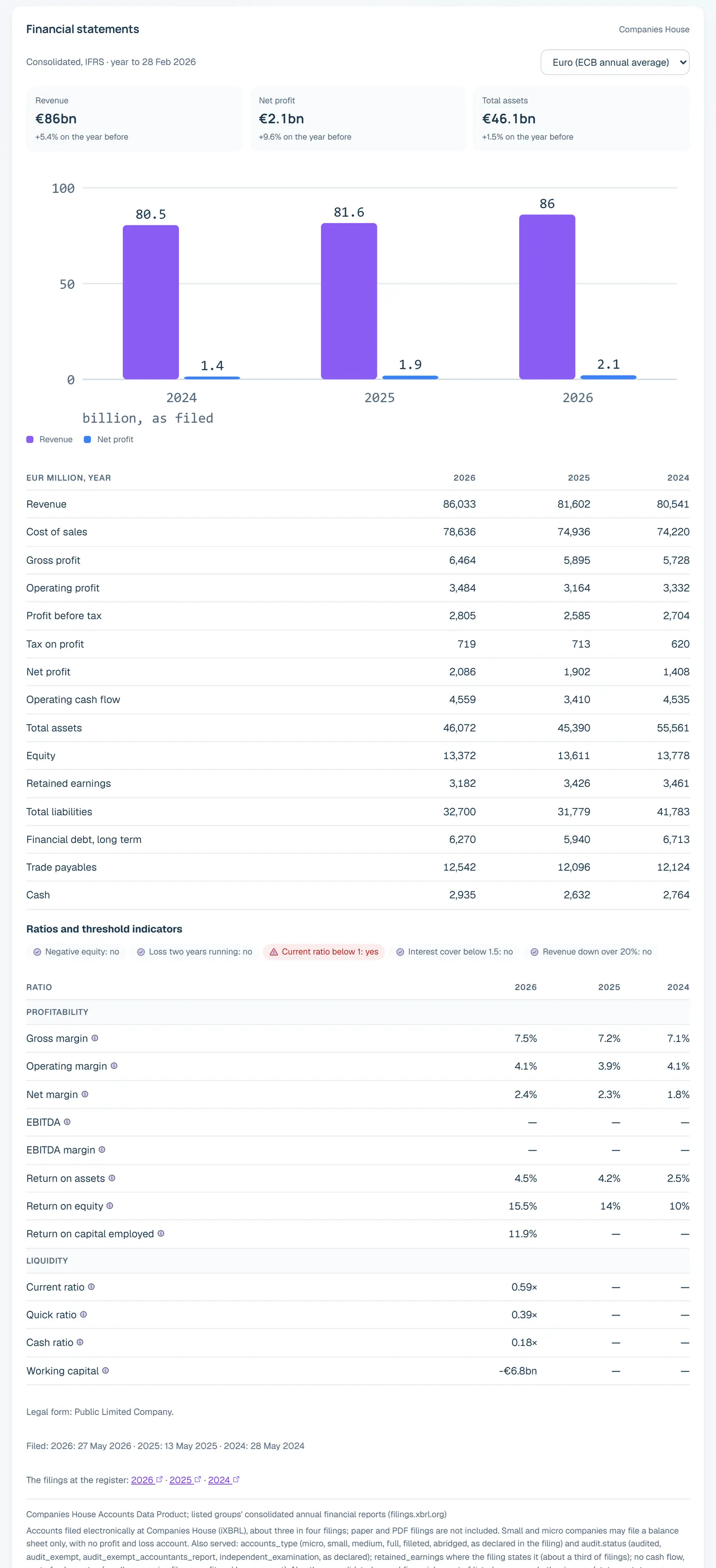
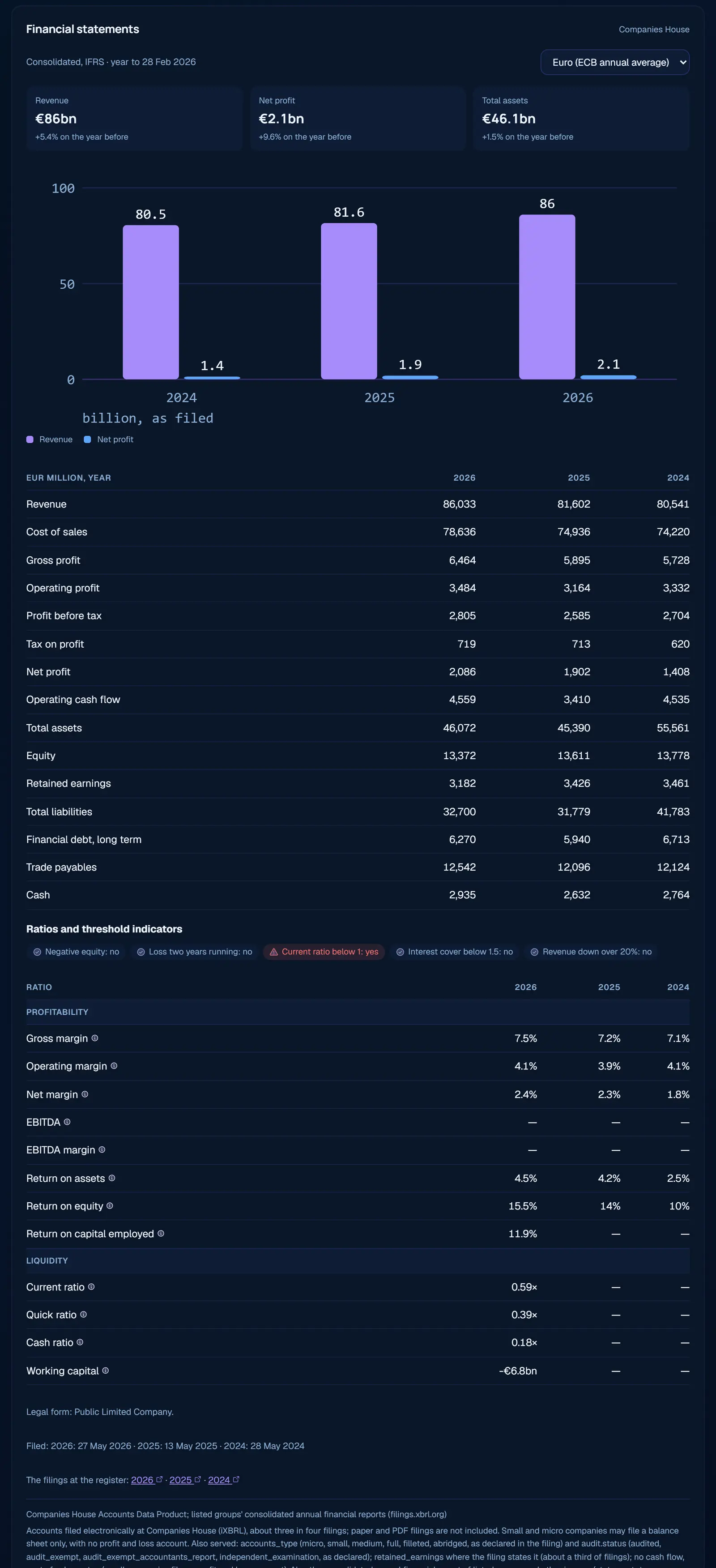
The comparable figures are revenue, gross profit, operating profit, profit before tax, net profit, personnel costs, depreciation, interest expense, total assets, fixed assets, current assets, cash, inventories, receivables, equity, current liabilities, non-current liabilities, total liabilities and employees. Euro figures use the ECB annual average rate of the fiscal year, for comparison; they are not an accounting translation.
Scope limits, stated plainly
- Annual accounts as filed with the register. No credit score, no rating, no estimate: the API does not compute either.
- Scale plan and above (EUR 99.99 a month). Starter, Professional and free trial keys get 10 calls a month.
- Countries: GB, FR, DK, SE, NO, LV, FI (digitally filed statements and listed groups), EE, LT and RO (headline figures only), GR (GEMI's balance-sheet announcements, read gradually), CO (Supersociedades filers), SEC filers in the United States, EDINET filers in Japan and listed companies only in ES, PL, HR, BE, SI, HU, LU, MT and BR, banks only in UA, insurers only in IE and general insurers in AU, plus tax records for FI, AU and PL; in NL, and in the LEI-registered layers IT, AT and PT, only the banks of the EBA transparency exercise, in HU and LU those banks and listed companies.
- France: accounts keyed by INPI (Registre national des entreprises) from the filed documents. Companies that declare their accounts confidential, about 45% of French filers, have no figures; where only the profit and loss account is declared confidential, it is left out. Filing currency is euro.
- The UK: electronic filings only, about three in four, and small and micro companies often file no profit and loss account.
- Denmark: digitally filed annual reports; most small companies report gross profit instead of revenue. Contains CVR data (Erhvervsstyrelsen), CC BY 4.0.
- Sweden: digitally filed reports only.
- Norway: the last three approved accounts, with no employee count.
- The last three fiscal years at launch, more as filings arrive.
- Euro at the ECB annual average of the fiscal year, for comparison.
- Finland: statements filed digitally with PRH, the Finnish Patent and Registration Office (XBRL, the company accounts; about one filer in twenty, registered since July 2023; no employee count; profit before tax is before appropriations), beside the ESEF reports of listed groups. Every Finnish company also carries
data.tax_records: the Finnish Tax Administration public corporate income tax data (CC BY 4.0) per tax year from 2020, where 0 means none, not unknown. Contains data from the Finnish Patent and Registration Office (PRH), CC BY 4.0. - Spain, Poland, Croatia and Belgium: listed companies only, with their ESEF annual financial reports (IFRS, mostly the group's consolidated accounts). Not every listed company's report is held; Polish reports arrive more than a year late, and the reports of Spanish listed companies are available free of charge on the CNMV website. Other companies there have none.
- United States: SEC filers only, with their annual reports (10-K, 20-F and 40-F) from EDGAR XBRL, US GAAP or IFRS, consolidated, fiscal years from 2023, in the filing currency (mostly USD) with euro at the ECB annual average; not for companies that do not file with the SEC.
- Latvia: full balance sheet and profit and loss account with employees as filed, consolidated statements separate, fiscal years from 2015 in euro, no cash flow, no filing date (Contains data from the Register of Enterprises of the Republic of Latvia (CC0)).
- Estonia: headline figures only, about sixteen summary items from the annual reports in the e-Business Register (assets, equity, revenue, profits, employee expense, head count), never a full statement, fiscal years from 2019, some figures read from PDF reports (Contains data from the Estonian e-Business Register (RIK), CC BY 4.0).
- Lithuania: headline figures only from the annual financial statements filed with the Register of Legal Entities (JAR), the balance sheet's section totals (fixed assets, current assets, equity, liabilities; total assets and total liabilities derived from them where the filing states neither) and the profit and loss account's sales revenue, profit before tax and net profit, never a full statement, individual and consolidated, fiscal years from 2023, in euro, no employee count; the register's open data held filings up to March 2026 at launch, so most 2025 accounts are not in it yet (Contains data from the Register of Legal Entities (JAR), Registrų centras, via data.gov.lt, CC BY 4.0. Adapted by Prometiam).
- Romania: headline indicators only (assets, equity, debts, net turnover, profit or loss, average employees) of companies filing with the Ministry of Finance, never a full statement, fiscal years from 2019, no banks, insurers or non-profits (Contains data from the Ministry of Finance of Romania (situații financiare, data.gov.ro), licensed under CC BY 4.0).
- Colombia: NIIF statements of companies supervised by the Superintendencia de Sociedades only (about 33,000 companies; banks and Superfinanciera issuers excluded), individual and consolidated, fiscal years from 2023, in pesos with no euro copy, no employees, personnel costs or depreciation; offered under CC BY-SA 4.0 like the Colombian records (Contains data from the Superintendencia de Sociedades (estados financieros NIIF), via www.datos.gov.co, licensed CC BY-SA 4.0. Modified by Prometiam; the Colombian records are offered under CC BY-SA 4.0.).
- Brazil: listed companies only (about 750, the CVM annual statements DFP, individual and consolidated), in reais with euro copies, fiscal years from 2023, under the Open Database License, a share-alike licence (Contains data from the Comissão de Valores Mobiliários (CVM), Portal Dados Abertos, licensed under the Open Database License (ODbL). Adapted by Prometiam.).
- Australia: financial statements only for general insurers supervised by APRA (APRA's annual institution-level statistics, one edition, years ended 31 March and 30 June 2023: total assets, total liabilities, net assets as equity, retained profits, income tax and net profit after tax, in Australian dollars rounded by APRA to the million, with euro copies; supervisory statistics rather than the audited accounts; no revenue) (Contains data from the Australian Prudential Regulation Authority (APRA), Annual general insurance institution-level statistics, licensed CC BY 4.0 (the workbook: CC BY 3.0 AU). Adapted by Prometiam; APRA does not endorse this product.); other companies, tax records only: the Australian Taxation Office Corporate Tax Transparency report per income year (total income, taxable income, tax payable) for large corporate tax entities (total income AUD 100 million and over), income years from 2013-14; a null taxable income or tax payable is withheld, never 0 (Contains data from the Australian Taxation Office (ATO), Corporate Tax Transparency report, licensed CC BY 3.0 AU. Adapted by Prometiam.).
- Japan: companies that file annual securities reports on EDINET only (listed companies and other issuers of securities): the consolidated and individual statements of the report as filed (J-GAAP; IFRS for the consolidated statements of IFRS filers), fiscal years ending 2023 on, in yen with euro copies, with the head count the report states (Source: Financial Services Agency, EDINET, under the Public Data License 1.0; edited and processed by Prometiam).
- Greece: the annual accounts from the balance-sheet announcements GEMI publishes when a company's approved financial statements are registered (Greek GAAP; AE, IKE and EPE companies; current and prior year), in euro; scanned, IFRS, consolidated and XBRL statements and statements in thousands are not served, and companies are read gradually, largest first, so most have none yet (Contains data from the General Commercial Registry (GEMI), Central Union of Chambers of Greece, ODC-BY-1.0).
- Slovenia and Malta, and in the LEI-registered layers Hungary and Luxembourg: listed companies only, their ESEF annual financial reports as collected by filings.xbrl.org, fiscal years 2022 on; the repository is not complete and adds reports with a delay (Contains annual financial reports published by the issuers (ESEF, IFRS), collected by XBRL International (filings.xbrl.org). Adapted by Prometiam.).
- Ukraine: banks only, the National Bank of Ukraine's per-bank financial reporting at 31 December of fiscal years 2023 to 2025 (total assets, total liabilities, equity, profit before tax, income tax and net profit), in hryvnia with no euro copy; supervisory reporting figures, not audited annual accounts (Contains data from the National Bank of Ukraine (open data, bank.gov.ua). Adapted by Prometiam.).
- Ireland: insurers and reinsurers only, the Solvency II figures they report to the Central Bank of Ireland (reporting years 2023 on, in euro: total assets and total liabilities at Solvency II valuation and revenue as gross premiums written; no profit, tax, head count or filing date); other Irish companies file their accounts as PDF images and have none (Contains data from the Central Bank of Ireland (SFCR template data, https://www.centralbank.ie), re-used under its public sector information licence. Adapted by Prometiam.).
- Banks in the EBA EU-wide Transparency Exercise 2025, in ES, FR, BE, SE, NO, PL, LV, SI, MT and NL and the LEI-registered layers IT, AT, PT, HU and LU: headline figures at 31 December 2024 only (total assets, total liabilities, equity and the profit for the year), consolidated indicator data rather than the bank's annual accounts, served only where no other source holds that bank's 2024 statement, and not updated; in NL, IT, AT and PT nothing else is served (Source: European Banking Authority, EU-wide Transparency Exercise 2025 (reproduction authorised, source acknowledged)).
- Poland also: tax records for taxpayers whose revenue exceeded the equivalent of EUR 50 million: revenue, costs of obtaining revenue, income, loss, tax base and tax due from the CIT return, tax years 2020 to 2025, in zloty, as the Minister of Finance publishes them once a year; tax figures, not accounts; tax capital groups and real-estate companies are not covered (Contains information published by the Minister of Finance of Poland under art. 27b of the CIT Act (gov.pl), offered under CC BY-SA 4.0. Adapted by Prometiam; the Polish tax records are offered under CC BY-SA 4.0.).
- France also: associations, foundations and endowment funds that publish their accounts in the Journal officiel (associations and foundations above EUR 153,000 a year of donations or public subsidies, and every endowment fund; deposits published from 20 November 2026): total assets, equity, the result and total income (donations, subsidies, dues and sales, not turnover), in euro, served only where the balance sheet totals agree (Contains information from the Journal officiel des associations et fondations d'entreprise (DILA, open data comptes des associations), Licence Ouverte v2.0).
- Latvia also: insurers' annual figures from Latvijas Banka's public quarterly report of insurers (the year to 31 December; fiscal 2025 at launch): total assets, equity, total liabilities, profit before tax, income tax and net profit, in euro; supervisory reporting rather than the audited accounts, no revenue, served only for a company-year the register's accounts do not give (Source: Latvijas Banka).
- United States also: the annual reports of Regulation Crowdfunding issuers (Form C-AR, from the SEC's Crowdfunding Offerings Data Sets), fiscal years from 2023: the cover page's total assets, cash, accounts receivable, revenue, cost of goods sold and net income as the issuer states them, in US dollars with euro copies; no debt, tax or head count.
FAQ
What does the company financials API return?
A company's annual financial statements as filed with the official register, mapped to one standard chart: revenue, gross profit, operating profit, net profit, total assets, equity, liabilities, cash, employees and more, for the last three fiscal years, in the filing currency and in euro, with a balance-sheet consistency check.
Which countries are covered?
GB, FR, DK, SE, NO, LV, FI (digitally filed statements and listed groups), EE, LT and RO (headline figures only), GR (GEMI's balance-sheet announcements, read gradually), CO (Supersociedades filers), SEC filers in the United States, EDINET filers in Japan and listed companies only in ES, PL, HR, BE, SI, HU, LU, MT and BR, banks only in UA, insurers only in IE and general insurers in AU, plus tax records for FI, AU and PL; in NL, and in the LEI-registered layers IT, AT and PT, only the banks of the EBA transparency exercise, in HU and LU those banks and listed companies. In France, accounts keyed by INPI, with none for companies that declare their accounts confidential; elsewhere, accounts filed digitally. Finland: statements filed digitally with PRH (about one filer in twenty, no employee count) and listed groups, plus tax records from 2020 for every Finnish company; contains data from the Finnish Patent and Registration Office (PRH), CC BY 4.0. Spain, Poland, Croatia and Belgium: listed companies only, with their ESEF annual financial reports (IFRS, mostly consolidated); not every listed company's report is held, Polish reports arrive more than a year late, the reports of Spanish listed companies are available free of charge on the CNMV website, and other companies there have none. United States: SEC filers only, with their annual reports (10-K, 20-F and 40-F) from EDGAR XBRL, US GAAP or IFRS, consolidated, fiscal years from 2023, in the filing currency (mostly USD) with euro at the ECB annual average; not for companies that do not file with the SEC. Latvia: full balance sheet and profit and loss account with employees as filed, consolidated statements separate, fiscal years from 2015 in euro, no cash flow, no filing date (Contains data from the Register of Enterprises of the Republic of Latvia (CC0)). Estonia: headline figures only, about sixteen summary items from the annual reports in the e-Business Register (assets, equity, revenue, profits, employee expense, head count), never a full statement, fiscal years from 2019, some figures read from PDF reports (Contains data from the Estonian e-Business Register (RIK), CC BY 4.0). Romania: headline indicators only (assets, equity, debts, net turnover, profit or loss, average employees) of companies filing with the Ministry of Finance, never a full statement, fiscal years from 2019, no banks, insurers or non-profits (Contains data from the Ministry of Finance of Romania (situații financiare, data.gov.ro), licensed under CC BY 4.0). Colombia: NIIF statements of companies supervised by the Superintendencia de Sociedades only (about 33,000 companies; banks and Superfinanciera issuers excluded), individual and consolidated, fiscal years from 2023, in pesos with no euro copy, no employees, personnel costs or depreciation; offered under CC BY-SA 4.0 like the Colombian records (Contains data from the Superintendencia de Sociedades (estados financieros NIIF), via www.datos.gov.co, licensed CC BY-SA 4.0. Modified by Prometiam; the Colombian records are offered under CC BY-SA 4.0.). Brazil: listed companies only (about 750, the CVM annual statements DFP, individual and consolidated), in reais with euro copies, fiscal years from 2023, under the Open Database License, a share-alike licence (Contains data from the Comissão de Valores Mobiliários (CVM), Portal Dados Abertos, licensed under the Open Database License (ODbL). Adapted by Prometiam.). Australia: financial statements only for general insurers supervised by APRA (APRA's annual institution-level statistics, one edition, years ended 31 March and 30 June 2023: total assets, total liabilities, net assets as equity, retained profits, income tax and net profit after tax, in Australian dollars rounded by APRA to the million, with euro copies; supervisory statistics rather than the audited accounts; no revenue) (Contains data from the Australian Prudential Regulation Authority (APRA), Annual general insurance institution-level statistics, licensed CC BY 4.0 (the workbook: CC BY 3.0 AU). Adapted by Prometiam; APRA does not endorse this product.); other companies, tax records only: the Australian Taxation Office Corporate Tax Transparency report per income year (total income, taxable income, tax payable) for large corporate tax entities (total income AUD 100 million and over), income years from 2013-14; a null taxable income or tax payable is withheld, never 0 (Contains data from the Australian Taxation Office (ATO), Corporate Tax Transparency report, licensed CC BY 3.0 AU. Adapted by Prometiam.). Japan: companies that file annual securities reports on EDINET only (listed companies and other issuers of securities): the consolidated and individual statements of the report as filed (J-GAAP; IFRS for the consolidated statements of IFRS filers), fiscal years ending 2023 on, in yen with euro copies, with the head count the report states (Source: Financial Services Agency, EDINET, under the Public Data License 1.0; edited and processed by Prometiam). Greece: the annual accounts from the balance-sheet announcements GEMI publishes when a company's approved financial statements are registered (Greek GAAP; AE, IKE and EPE companies; current and prior year), in euro; scanned, IFRS, consolidated and XBRL statements and statements in thousands are not served, and companies are read gradually, largest first, so most have none yet (Contains data from the General Commercial Registry (GEMI), Central Union of Chambers of Greece, ODC-BY-1.0). Slovenia and Malta, and in the LEI-registered layers Hungary and Luxembourg: listed companies only, their ESEF annual financial reports as collected by filings.xbrl.org, fiscal years 2022 on; the repository is not complete and adds reports with a delay (Contains annual financial reports published by the issuers (ESEF, IFRS), collected by XBRL International (filings.xbrl.org). Adapted by Prometiam.). Ukraine: banks only, the National Bank of Ukraine's per-bank financial reporting at 31 December of fiscal years 2023 to 2025 (total assets, total liabilities, equity, profit before tax, income tax and net profit), in hryvnia with no euro copy; supervisory reporting figures, not audited annual accounts (Contains data from the National Bank of Ukraine (open data, bank.gov.ua). Adapted by Prometiam.). Ireland: insurers and reinsurers only, the Solvency II figures they report to the Central Bank of Ireland (reporting years 2023 on, in euro: total assets and total liabilities at Solvency II valuation and revenue as gross premiums written; no profit, tax, head count or filing date); other Irish companies file their accounts as PDF images and have none (Contains data from the Central Bank of Ireland (SFCR template data, https://www.centralbank.ie), re-used under its public sector information licence. Adapted by Prometiam.). Banks in the EBA EU-wide Transparency Exercise 2025, in ES, FR, BE, SE, NO, PL, LV, SI, MT and NL and the LEI-registered layers IT, AT, PT, HU and LU: headline figures at 31 December 2024 only (total assets, total liabilities, equity and the profit for the year), consolidated indicator data rather than the bank's annual accounts, served only where no other source holds that bank's 2024 statement, and not updated; in NL, IT, AT and PT nothing else is served (Source: European Banking Authority, EU-wide Transparency Exercise 2025 (reproduction authorised, source acknowledged)). Poland also: tax records for taxpayers whose revenue exceeded the equivalent of EUR 50 million: revenue, costs of obtaining revenue, income, loss, tax base and tax due from the CIT return, tax years 2020 to 2025, in zloty, as the Minister of Finance publishes them once a year; tax figures, not accounts; tax capital groups and real-estate companies are not covered (Contains information published by the Minister of Finance of Poland under art. 27b of the CIT Act (gov.pl), offered under CC BY-SA 4.0. Adapted by Prometiam; the Polish tax records are offered under CC BY-SA 4.0.). France also: associations, foundations and endowment funds that publish their accounts in the Journal officiel (associations and foundations above EUR 153,000 a year of donations or public subsidies, and every endowment fund; deposits published from 20 November 2026): total assets, equity, the result and total income (donations, subsidies, dues and sales, not turnover), in euro, served only where the balance sheet totals agree (Contains information from the Journal officiel des associations et fondations d'entreprise (DILA, open data comptes des associations), Licence Ouverte v2.0). Latvia also: insurers' annual figures from Latvijas Banka's public quarterly report of insurers (the year to 31 December; fiscal 2025 at launch): total assets, equity, total liabilities, profit before tax, income tax and net profit, in euro; supervisory reporting rather than the audited accounts, no revenue, served only for a company-year the register's accounts do not give (Source: Latvijas Banka). United States also: the annual reports of Regulation Crowdfunding issuers (Form C-AR, from the SEC's Crowdfunding Offerings Data Sets), fiscal years from 2023: the cover page's total assets, cash, accounts receivable, revenue, cost of goods sold and net income as the issuer states them, in US dollars with euro copies; no debt, tax or head count.
Why is a figure null?
A figure is null when the filing does not state it. Small and micro companies in the UK often file no profit and loss account, and most small Danish companies report gross profit instead of revenue.
Which plan includes it?
The Scale plan and above, from EUR 99.99 a month. Starter, Professional and free trial keys get 10 calls a month.
Is this a credit score?
No. The API returns the accounts as filed, with a consistency check and flags for derived figures. It does not compute a credit score or a rating.
Do you give the date the accounts were filed?
Yes. Every statement carries filing_date, the day the filing was filed with or published by the register: the date those accounts became public. A comparative figure carries the date of the later filing it was read from. The sources for Norway, Latvia, Romania and Colombia publish no date, so it is null there and quality.missing says why.
Related
- Supplier due diligence — resolve, verify, screen and monitor a supplier
- KYB onboarding — verify a business at onboarding
- Customer insolvency monitoring — catch a customer failing before the invoice bounces
- KYB API — verify, monitor and screen the company behind the accounts
- Company monitoring API — webhooks when the company changes
- All use cases
- API documentation
- Pricing
- Esta página en español
- Cette page en français