Use case · AML / sanctions
Sanctions Screening API BETA
Sanctions screening is beta. One REST call screens a name against the EU consolidated, UN, OFAC, the UK Sanctions List (FCDO), the Australian DFAT Consolidated List, and French Registre des gels sanctions lists, plus the full US Consolidated Screening List of export-control lists — seven sources, with scored fuzzy matching, alias-level match explanation, and webhook watchlist monitoring.
dob/country disambiguators to control false positives. Included in the Professional tier.The problem
Sanctions screening is the AML control most likely to be checked in an audit and the most likely to be implemented poorly. The standard failure modes: only screening one list (EU but not UN, or OFAC but not UK), exact-match-only screening that misses transliteration variants, lists refreshed weekly instead of daily, no confidence scores, no match-explanation. Each official list is published in a different format under a different schedule by a different authority.
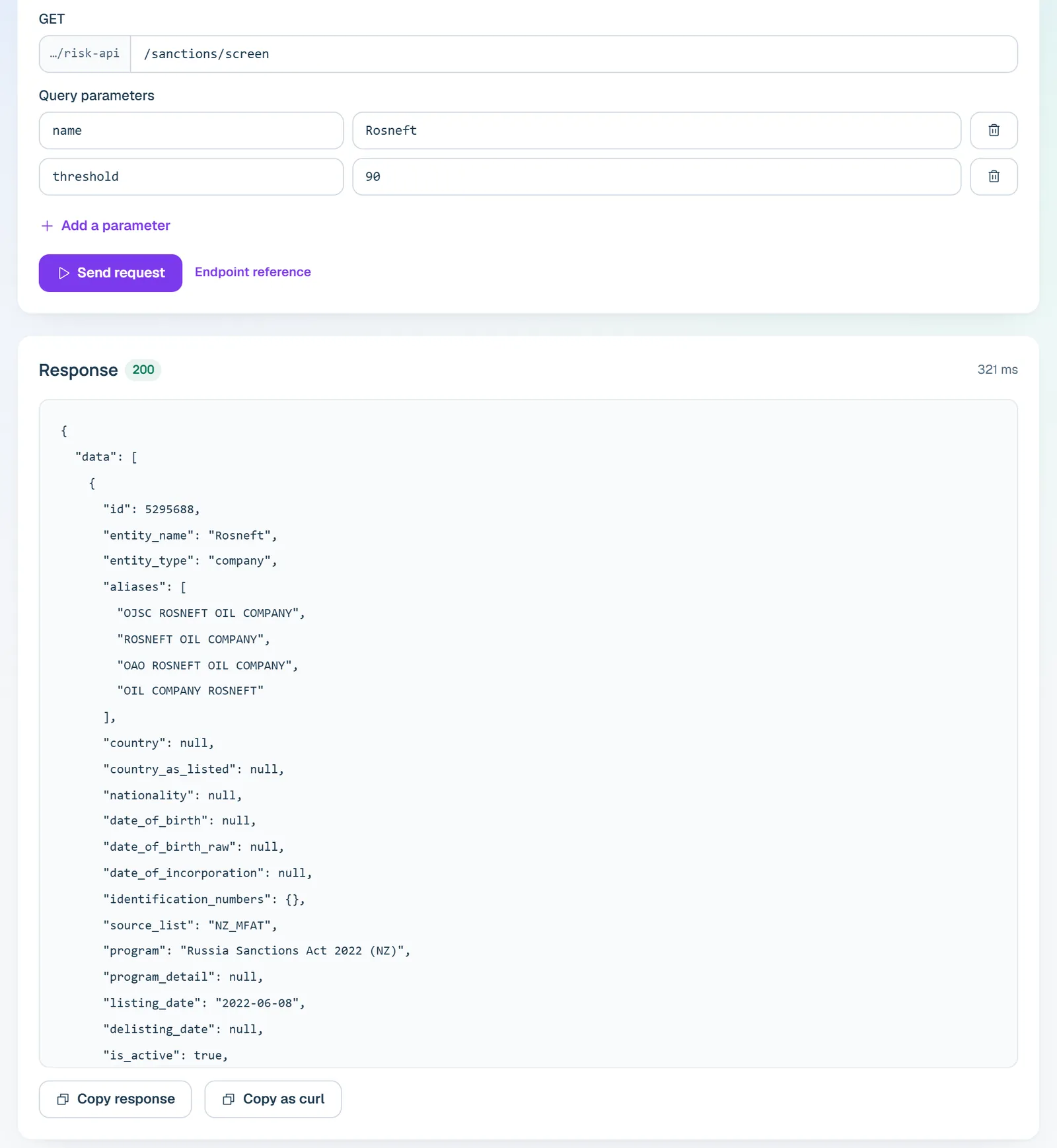
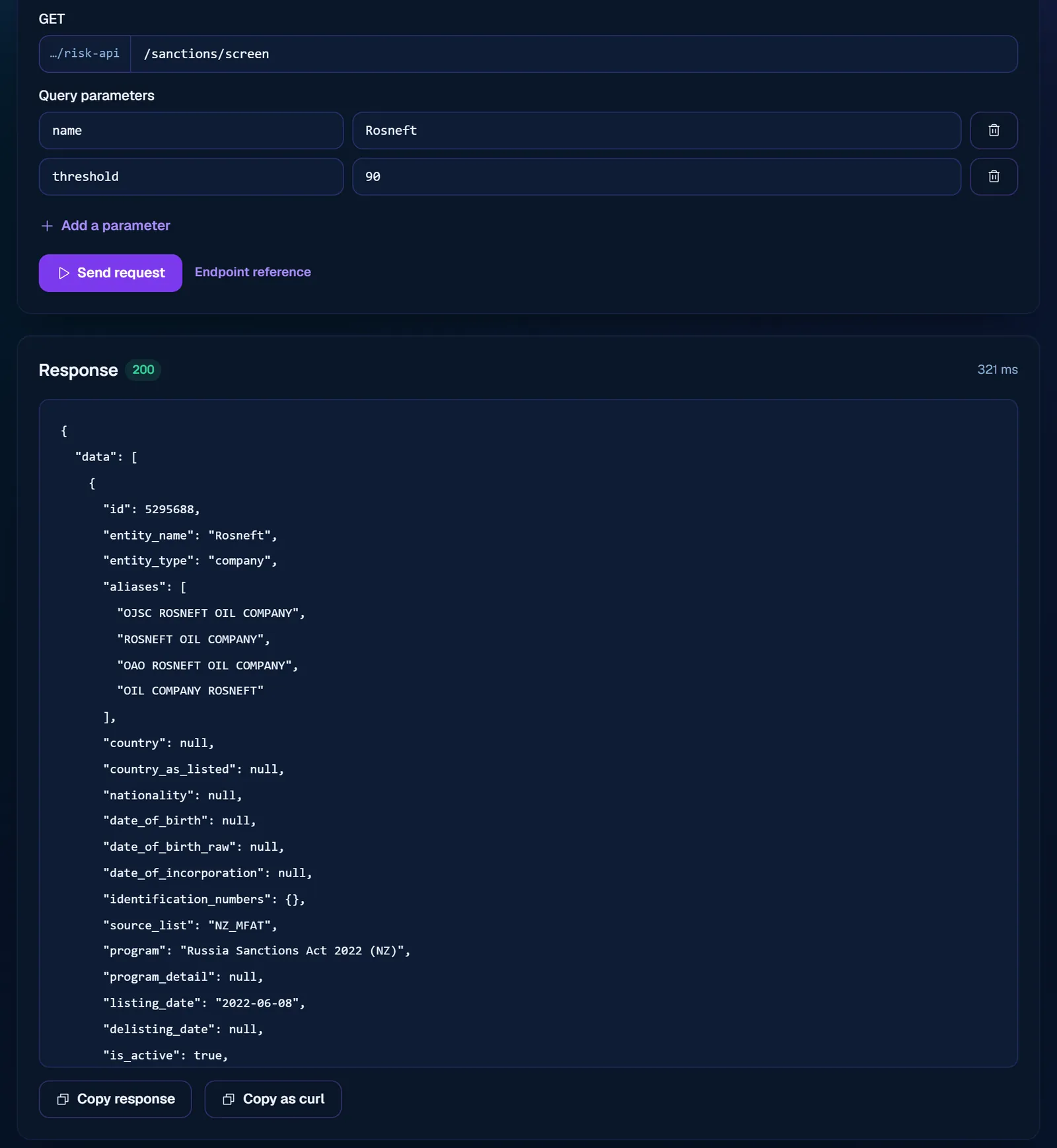
Prometiam's /sanctions/screen endpoint does the seven-source union, the fuzzy match, and the confidence scoring in one call so the integrator just sets a threshold and reads matches. For continuous monitoring, /sanctions/watchlist checks your counterparty names against every daily list change and calls your webhook on a hit.
The 30-second integration
# Screen a person name with default 80% threshold
curl 'https://api.prometiam.com/functions/v1/risk-api/sanctions/screen?name=Juan%20Perez&threshold=80&entity_type=person' \
  -H 'Authorization: Bearer rk_live_...'

# Screen a corporate name (any entity type)
curl 'https://api.prometiam.com/functions/v1/risk-api/sanctions/screen?name=Acme%20Trading%20S.A.&threshold=85' \
  -H 'Authorization: Bearer rk_live_...'

# Vessel only — IMO-named ships and similar
curl 'https://api.prometiam.com/functions/v1/risk-api/sanctions/screen?name=MV%20Black%20Sea&entity_type=vessel' \
  -H 'Authorization: Bearer rk_live_...'
The response shape
{
  "data": [
    {
      "id": 90212,
      "name": "JUAN PEREZ",
      "type": "person",
      "score": 92,
      "list": "EU",
      "list_url": "https://webgate.ec.europa.eu/.../...",
      "added_on": "2024-09-12",
      "country_of_birth": null,
      "aliases": ["JUAN A. PEREZ", "J. PEREZ"]
    }
  ],
  "meta": {
    "query_ms": 47,
    "rate_limit": { "rpm_remaining": 199, "daily_remaining": 9999 }
  }
}
Each hit includes the source list (EU, UN, OFAC, OFSI (the UK Sanctions List, published by the FCDO), DFAT (Australia), FR_GELS, plus US export-control lists such as US Entity List (BIS)), a confidence score, and a link to the official list entry for audit. aliases is the union of every alternate name on the underlying record so reviewers can see why the match fired.
Threshold tuning
The threshold parameter trades false positives against false negatives:
- 50–69: very loose. Useful for human-in-the-loop review where the cost of missing a match dominates. Most names will return at least one weak hit.
- 70–79: liberal. Catches transliteration and short-name variants. Expect ~5% false-positive rate on common names.
- 80 (default): balanced. Catches most variants without flooding reviewers.
- 85–90: strict. Production default for high-volume payment processing where review cost is high.
- 95+: near-exact. Only use when you've already done the full screen at 80 and want a fast hot-path pre-check.
Best practice: run at 80 in onboarding, queue all hits ≥85 for automatic block, send 80–84 to a manual reviewer.
Compliance documentation
Every successful response includes list_url pointing at the canonical source-list entry. For audits and SARs (Suspicious Activity Reports), keep the list_url, the added_on date, the matched name, and the score in your transaction log. Combined with the timestamp of the call (returned in the response headers), that's a defensible audit trail.
Aligned with EU Regulation 2580/2001 (terrorist sanctions), UN Security Council resolutions, US OFAC SDN list (31 CFR 501), and the UK Sanctions and Anti-Money Laundering Act 2018.
Pricing fit
Sanctions screening is a Professional-tier scope. The Professional plan (€29.99/month) covers 10,000 credits/month, 120 RPM — about 3,300 screened names a month at 3 credits each. A fintech onboarding 1,000–5,000 counterparties / month with 5–10 sanctions screens each (15,000 to 150,000 credits) needs Scale (€99.99/month, 50,000 credits/month, 300 RPM) at the low end and an Enterprise allowance beyond it.
Standalone screening vendors (ComplyAdvantage, LSEG World-Check) don’t publish pricing for equivalent volume — it is quoted. They are worth it if you also need PEP and adverse-media coverage which Prometiam does not provide. For sanctions-only, Prometiam is materially cheaper.
FAQ
Which lists?
EU consolidated, UN, OFAC SDN, UK Sanctions List (FCDO), Australian DFAT Consolidated List, French Registre des gels, plus the US Consolidated Screening List. Single call, all seven sources.
What kind of matching?
Trigram fuzzy. Robust to spelling, transliteration, and punctuation. Confidence score per match.
How fresh?
Daily refresh on all seven sources. added_on per match for audit.
Persons or entities?
Both. entity_type = person, entity, vessel, or any (default).
How does this fit a KYB pipeline?
See KYB onboarding for the full pattern with code.
On the 14-day free trial?
Up to 25 calls a month, to try it. Full sanctions screening is Professional-tier.
Related
- Sanctions list search — the official OFAC, EU, UN and UK search tools and what screening a counterparty properly means
- KYB onboarding — sanctions in the verification flow
- Counterparty monitoring — recurring sanctions re-screen
- Director-network analysis
- Companies House API alternative — pairs CH data with sanctions